AI-&-Cybersecurity--Dan-Boneh-Interviews
https://m.youtube.com/watch?v=940zih5bee4&pp=ugUHEgVlbi1VUw%3D%3D

Welcome back, everyone.
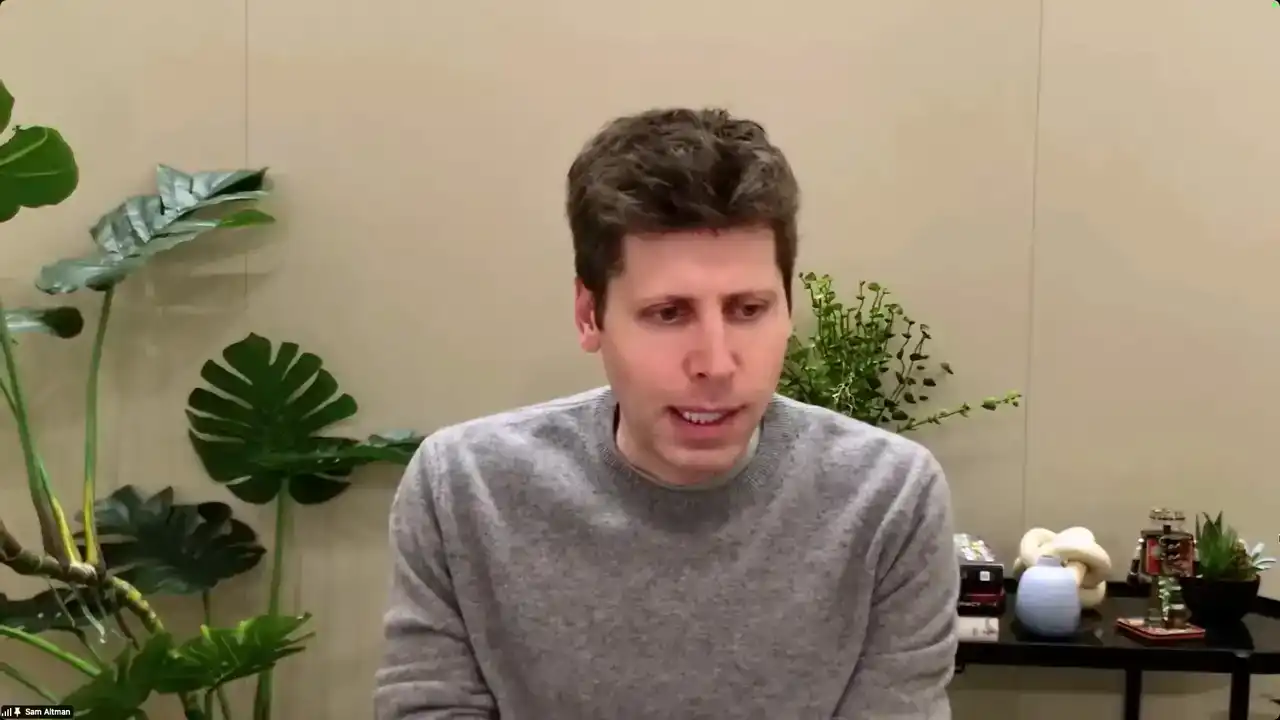
In this segment, we have a special guest, Sam Altman,

who will tell us all about AI as a career choice. Sam is a founder and CEO of OpenAI. Before OpenAI, Sam was the president of Y Combinator. Before that, he was the founder and CEO of Loopt. And before that, he was a student at Stanford.
I have to tell you one story about Sam. In my courses at Stanford, I often pose hard problems for the students to think about. And I can tell you that in all my years of teaching, Sam was the only undergraduate who ever came up with a novel research idea on any of these problems. So that's Sam for you. Sam, welcome. And thank you so much for taking the time to speak with us. Of course.
Really happy to get to do this.

Awesome. Okay.
We have a lot of questions to discuss.
So why don't we dive right in? So I wanted to start with sort of a high-level question just to kind of set the tone. And so just in your mind, what would you say are the biggest open questions in AI for people to work on?
There's still so much. I think we've identified this one incredible thrust of deep learning. And we've seen how far that can go. But I think we're still in the very early innings. The way we do these systems gets so much better every year. I think that'll keep going for a long time. Data efficiency is still a huge problem. That's still one thing that humans can do very different than these systems. I think the way that we sort of separate these concepts of pre-training and RL, somehow there's something new to discover there. But I think we could go on for a long time about all the things we still don't know. Like we have one piece of magic, which is this algorithm that can learn. And we keep finding new ways to do more impressive things with that. Like it's only been two and a half years since ChatGPT launched. If you go back and use that original version, it's quite bad. So the rate of progress is still super steep, but the list of problems in front of us and the list of unknowns still just is huge. You know what it's going to take to build a system that can go autonomously discover new science, which for me is very important to go build. Still a lot of work to do.
So a lot of people talk about the training data problem that we're kind of running out of training data. Is that, do you think, an area where there's a need for a lot more work?
You know, that's another way of saying the data efficiency problem. We're not running out of data if we can learn way, way more from each byte of data.
How is it that we are able to learn from kind of just our senses?
I would like to know that. You know, that's interesting. Clearly, the way these systems are learning and the way we learn is a little bit, at least a little bit different. Maybe it's very different. But, yeah, the human ability to learn from a single data point, quite impressive.
Just a few data points and we're able to generalize. These things need, for some reason, they need a lot of data points and they generalize for that. So I guess there's a lot more to do in terms of figuring out exactly how we are able to do it. You know, it's interesting. One of the questions that comes up is, are we just trying to build human abilities or are we trying to go beyond human abilities?
um i think in many ways these systems are already beyond human abilities not in every but but like they're certainly vastly superhuman at some things
yeah it's funny one of our uh ai faculty likes to say that uh our the goal of ai is sort of not to build humans we already know how to make humans but the question is basically how do We built something different. And I guess that's kind of where you're going.
You know, in some sense that you can tell a story of sort of like human civilization, which is what matters. The super intelligence that already exists is not any one genius's brain, but it's the scaffolding and that sort of technology tree and tool chain that we all create between us. So it's all of the accumulated knowledge, artifacts, tool chain that builds on each other over time. And like no one person could go from digging stuff out of the ground to producing a computer. There's a lot of stuff that has to go into that. But collectively, society is able to do this crazy thing. And we make scientific discoveries. We can manipulate matter in new ways. We can do all these amazing things. and you know like ai will just in some deep sense be another contributor to that scaffolding outside of anyone's neural network human or artificial um and if the ai goes off and like discovers novel physics and then humans can use that to do new things like is that going to feel like the ai was the super intelligence is that going to feel like the scaffolding just got taller I don know Oh my God I can wait until an AI actually writes the first research paper that gets published in a journal
Maybe not that long. Yeah, that would be awesome. So I want to switch gears a little bit and kind of clearly there's a lot more to do in AI. Well, I would say it sounds like you're saying also that we're really only the beginning of this journey. The area is going to grow dramatically. There's no fear of lack of things to do in AI. So if students decide to go into AI, it sounds like there's a lot to do.
Look, I'm biased, and you should always be skeptical of anyone talking up their own book, but I think it is the best field to go into right now.
Okay, great. I'm glad you said that because it's exactly what I wanted to ask about. So, you know, the people that are taking this class, They have obviously generally folks who work in computer science have a lot of different areas they can work in. So people can work in finance. They can work on consumer apps. They can work on biotech. Maybe they can work on a technology for education. There's like lots of different areas that once you have CS knowledge, you can contribute to society with. So what advice would you give to someone who, say, is considering an offer from an AI company or an AI startup versus, say, a company that's working in finance or biotech? Or how do you decide which of these areas you would like to go into?
First of all, you should do whatever you most want. And you should work with the people that you're excited about, the problem that sort of speaks to you, whatever. And I think that is more important than any piece of generic advice. But if you want the generic advice, at any given time in human history, there are only a small handful of most important scientific frontiers to push on. And, you know, at different times in history, it's been physics or biology or parts of computer science or building out the Internet. But right now, I think the top one is building our knowledge and understanding and deployment of artificial intelligence. I think it's the most important trend of right now. It's probably the most important trend of this generation. That might be the most important thing of a much longer period of time. And it's very lucky to be alive and working during such an incredibly huge tectonic shift. and my biased and generic advice is you have the opportunity for this to be the most important work you ever touch in your life, and you should jump on that.
Yeah, so this is kind of a unique time. It feels like a very special time. Yeah, where AI is kind of the main technology that's being developed, so why would you not be part of this?
The main technology that's being developed, it's also the thing that will have probably the biggest sort of total impact on everything else.

Yeah, that actually makes total sense. And so I guess our audience, when they evaluate different job offers, I guess it kind of makes sense to think about, obviously you want to be in a company that's leading development.
I think so.
Yeah, makes complete sense. And so let's try to kind of fast forward a few years and say, it's always hard to predict the future, but let's try to predict the future. I'm just curious how you think of this. So if we fast forward five, maybe 10, maybe even 20 years, do you think AI is going to be as hot as it is today? Or do you think at some point it's going to peak and some other area will take over? Of course, that's going to happen eventually, but how long is it going to take?
The world will be more dependent on it, but the world may be so used to it that we don't think about it in the same way. I remember in the app store launch like 2008 or something. There were a couple of years right after that where everybody was talking about, you know, I'm going to be a mobile first, whatever.
I'm a mobile company.
I'm a mobile this. I'm this but mobile. And then if you go back 10 years earlier towards the Internet boom, I've heard that everybody like it was the dot com boom. Everyone was dot com. It was like the hot thing. And then there was a moment where each of those got an incredible amount of hype and focus. But pretty quickly after, you didn't talk about being an internet company anymore because every company that had an internet strategy. And only a few years after that App Store launched on the iPhone, no one talked about being a mobile company anymore because it was just like if you weren't, it didn't make sense. I hope that in five or ten years, AI is like that. And no one talks about being an AI company anymore. We expect every product and service to be really smart And I excited for that world It might mean that AI has less hype than it does today but it be way more powerful and way more integrated into our lives and everything will be, you know, using AI.
What is it? There's a definition of technology, which is everything that was invented after you were born. So it's kind of amazing that like kindergartners today, they are not going to know a world without ChatGPT.
I have a baby and I spend a lot of time thinking about how he will never be smarter than AI. But he will also never grow up in a world where he does not expect computers, products and services, whatever, not to be really smart and understand him and do whatever he needs.
Since you brought it up, I'm really curious. How would you think about preparing your child for a world like that?
I mean he'll be able to do things that are just astonishing like it's when I was a kid computers were this amazing thing I was much better at them I was much better at using them than my parents were they were still kind of they were not new but they were like not as integrated into life as they are now and And I don't think my parents would have known what to do to prepare me for a world with computers other than say, this feels like it's going to be important. You know, you seem interested and I will encourage that. And I don't know what else I can do for my kid besides say, this I think is going to be important, learn to use it. You'll be able to do more things with it than I could have done without it. And that's great. Like, I want you to accomplish way more than I could accomplish if you want. and but I think I think that's the answer there's like there's there's like the big things to do you know teach kids to be resilient and adaptable and curious and creative and all that but the tactical thing to do is just trust that with new tools people will do more and encourage our kids to be very fluent with these tools which they probably will be anyway
but you know it's interesting you say this because for example when cars came along you know there's a most of the population basically knew how to drive a car how to use a car but they couldn't tell you how a car works and a small fraction of the population actually dove into actually building engines and you know understanding exactly you know tinkering there was a whole subculture of people tinkering with engines and kind of making making cars do all sorts of things they weren't designed to do and so on and the same thing by the way with computers right most of the population knows how to use the internet but they couldn't tell you how a computer works. And then there's a segment that actually focuses on kind of playing and kind of pushing
computers to the limits. I'm curious if you think the same thing is going to be about with AI, like the population will be used to using AI, they'll see it everywhere. But probably only a smaller segment will actually understand how deep neural networks work, how to kind of push it to do
new things. For sure. And I think that's great. Like most people who use people do incredible things with computers without knowing how, you know, the detail of it works. But that's like, that's how specialization of labor and this sort of like shared tool chain of progress work like i think the most important skill in the future will not be able to be will not be being able to build ai but being able to use ai to do amazing things with it um just like you know today maybe maybe like researchers at open ai don't know everything that it would take to go build a computer from the ground up but they know how to use that computer to create agi and that's a really that's like the next valuable layer to build. And then on top of AGI, there will be a new thing to build. And someone will have to go figure that out. But they may not need to know how to like train a neural network.
Okay. I was actually hoping you would say that there's actually a need to know the technology and understand how it works.
For some people there is. Yeah. But, you know, and I think it's like an incredible, for now, it's maybe the most valuable skill in the world. Even going forward, it will still, I think, be valuable. My point was just as we kind of try to imagine 10 years, 20 years out, there may be even more exciting new things we can't imagine yet.
I see. That's actually a really interesting point. So like for our computer scientists today, it's kind of valuable to know how DNNs work and how to train them and so on. Maybe coming up with new ideas for how to build DNNs or other types of learning algorithms. But you're saying further out, this is going to be a tool in our toolbox.
I think so.
yeah well i can just assume it works and uh you know i don't know how to make a calculator or

maybe i could do it but it would be like the very limits of what i remember about electrical engineering and such um and i but i never think about how to make a calculator i still use one a lot and there's like a bunch of important like things in there for me but but like it like a tool that lets me go think about higher level problems or go work on like more powerful stuff You hear Yeah I certainly don know how to go make a computer Yeah No that makes perfect sense So it makes sense for people to kind of come focus on new applications for AI new things

that we haven't seen before. And maybe that's kind of the cutting edge of where things will go. Yeah, this is amazing. So it's really, it's really interesting to see. We're kind of moving into a really interesting future. So I guess the next five, 10 years are going to be pretty exciting.

Should be incredible.
Yeah. Great. So I want to change gears a little bit and actually talk about kind of the topic of this course. So this course is really about the security of AI systems. So what does it mean for an AI system to be secure? What does it mean for even trying to kind of make it do things it wasn't designed to do? And so during the course, we talked about various attacks, like I'm sure you know prompt injection attacks, things called adversarial examples. They're trying to confuse the model. Things like model extraction, we're able to extract the model by interacting with it. And there's a whole list of these. It's kind of AI security is kind of a big topic. Of course, we also talked about defenses. How do we protect AI systems from prompt injections and other attacks like that? So I'm curious how you, of all the areas of AI, it's a pretty broad field. It has a lot of sub areas, right? Some people work on training, some people work on inference. And how do you think of AI security? And you think, I guess the concrete question I want to ask is, among all the different things we can do with AI, this course is about learning one sliver of the field. Is this a good
area? Should people go into this? I think this is one of the best areas to go study. I think we are soon heading into a world where a lot of the AI safety problems that people have traditionally talked about are going to be recast as AI security problems in different ways. I also think that given how capable these models are getting, if we want to be able to deploy them for wide use, the security problems are going to get really big. You mentioned many areas that I think are super important to figure out. Adversary robustness in particular seems like it's getting quite serious. One more that I will mention that you touched on a little bit, but just it's been on my mind a lot recently. There's two things that people really love right now that taken together are a real security challenge. Number one, people love how personalized these models are getting. So ChatGPT now really gets to know you. It personalizes over your conversational history, your data you've connected to it, whatever else. And then number two is you can connect these models to other services. They can go off and like call things on the web and, you know, do stuff for you that's helpful. But what you really don't want is someone to be able to exfiltrate data from your personal model that has, that knows everything about you. And, you know, humans, you can kind of trust to be reasonable at this. If you tell your spouse a bunch of secrets, you can sort of trust that they will know in what context what to tell to other people. the models don't really do this very well yet. And so if you're telling like a model all about your, you know, private healthcare issues, and then it is off, and you have it like buying something for you, you don't want that e-commerce site to know about all of your health issues or whatever. But this is a very interesting security problem to solve this with like 100% robustness.
Yeah, so that's an example of something that you could literally make a career out of this, right? is like your entire intention.
AI security, I think, is probably a very, very undervalued field right now. Yeah.
I mean, so I guess the reason I'm asking this is when you look at the web companies, the traditional technology companies like Google, Amazon, they literally have thousands of engineers working on securing the platform. And it sounds like the AI companies are going to have to start investing pretty heavily in building AI security teams. So, you know, when you look at our audience, you know, they're wondering what should what area should they focus on? Suppose they want to switch to AI. What should they focus on? You're saying that probably there's going to be a lot of demand for expertise in AI security.
Yeah, that's fantastic. I'm so happy to hear you say that.
I guess on the question of AI security, there's kind of the other the flip side of it. I'm curious how you think about this. So so far we talked about security for AI. There's also this question of AI for security. Yeah. Which is really interesting. Yeah. It's really interesting. The fact that the chat GPT is amazing at finding bugs in software. Yeah. It's really cool.
We're starting to do a lot more work on this here. I think that, I think that we should be like a superhuman, you know, AI security. security, analyst, whatever you want to call it, pretty soon.
Right. So that sounds like a pretty serious growth area, right? Using basically AI to test software.
Yeah. By the way, it works both directions. Like you can use it to secure systems. I think it's going to be a big deal for cyber attacks.
Oh, my God. I'm so glad you said that. I'm so glad you said that. So it's kind of odd. Like when we talk about AI finding vulnerabilities, people immediately think about, oh, my God, the offensive capabilities. But the reality is, before you ship your code, you're now going to use an AI system to test your code to find vulnerabilities, and then you're going to fix them.

Yeah.
So perhaps this is kind of an opportunity for OpenAI, that you guys can actually do software testing.

I think so.
Yeah. So you see that as a potential area where people could focus a lot of their time on.
Yeah. Yeah. Yeah. Amazing.
Okay, cool. So this is wonderful. I wanted to also talk a little bit about kind of your opinion of kind of the impact of AI generally on computer science. And so this touches on what we just discussed. But I have to say, it's really kind of remarkable. I know whenever I need to write code, I actually don't write code anymore. I kind of write pseudocode. And then I go to ChatGPT or any of the other engines and kind of convert my pseudocode into real code. My PhD students use this all the time. It's amazing to see this in action. It accelerates their life dramatically and it makes life so much easier for them. So I'm really curious, since a lot of our audience are developers, people who write code, I'm kind of curious to hear your thoughts on what do you think software development would look like in 2, 5, 10 years?
Really different than it looks right now. I think it'll mostly be like talking to a computer. You know, maybe you express pseudo code. Maybe you express something much closer to English.
If I'm a company building, I don't know, like an app for whatever, you know, deciding on which books to buy or whatever. Yeah. You know, today I hire product managers that write specs. And then I hire an army of developers that implement the specs. how do you think that's that's gonna change in the future i think to make the first version you'll

just like describe the software you want and then maybe you know you'll have something we'll have to like think overnight and go write and test the code and you'll wake up the next morning and you'll have that like book selling thing and then as the system gets bigger and more complicated uh you'll have you know people you'll have like these kind of software engineering agents crawling around your repo, doing stuff for you, and writing tests, checking in code. And you'll just sort of, you could even imagine automating a lot of the rest of what goes into a company too, not just the software development, but the software development, I think there's a clear path to like, okay, we get how this is going to work.
Right. So it's basically going to make our developer developers a lot more productive. Yes. And yeah. So that's kind of the view. You're going to describe what you want rather than actually writing the code as we do today.
I think so.
Yeah, amazing. This is pretty cool. So I have to ask, because obviously I'm an educator, so I have to ask also what you think computer science education will look like in five to ten years. So, you know, today we teach operating systems, we teach C++, we teach compilers. What are we going to be teaching in five to ten years?
um when i when i came to school uh i remember sitting in 106x and they were teaching us how to like you know write a sword algorithm or whatever and i was like i don't think i'm ever gonna have to it's kind of interesting it's teaching me something about how to think but i don't think i'm ever gonna have to do this again in my life like you know why don't you like teach me how to like write a web app or something that was the thing at the time. And I felt like we were being taught kind of 10 years behind the frontier of what would have been most useful to me to learn. And I think now there's like a version of that happening again, where what it looks like to write code has changed so much in the last two years. It'll change so much in the next two. It feels to me like the curriculum and the way we teach should, the way we teach like intro to CS or intro to programming, let's call it, should probably change quite a lot.
Trevor Burrus Should change completely like as in... David Pérez I think so.

Trevor Burrus I think so.
Trevor Burrus We should still be teaching CC++ though, no? Or whatever language we think is appropriate.
David P Somewhat but I think the mix of that relative to teaching how to people people like how to like write code in a world of software engineering agents there probably some other things to teach at a higher percentage of the mix
Wow, that's going to take some thinking.

I think that's going to take some thinking. I was happy to learn C++. There were some interesting parts of it, but if I think about the day job of someone who's going to really contribute to creating very valuable software in the future, I bet it looks very different from the way we would teach that class.
So let me try this argument on you. I'm curious to see what you think of it. So in high school or in elementary school, we still learn how to add and multiply numbers, even though we don't really need to add and multiply numbers. We have calculators, but we still need to learn how to do it just so we understand the world we live in. Do you think that like learning operating systems and compilers is kind of the same thing that we need to learn it just to know it, but we're not going to use it?
It's interesting. So, like, I remember in elementary school, I had a teacher tell me, like, you really need to learn, like, basic edition. And I was like, well, there's a calculator, so why? And they're just like, well, because I said so. That same teacher told me I had to learn cursive. That's the way people used to write. And it was very clear to me then that I was just not going to ever do that again. Like, that was just, you know, a kind of crazy thing. And I was like, this doesn't make any sense either. So, how to know, like, which things are important to learn or not seems very difficult. Again, the meta skill of learning how to learn is super valuable. And so in some sense, learning anything is valuable because you do pick up on something else. I am very happy to know something about how operating systems work and something about how compilers work. I would argue most people, the value they're going to get out of that is the general meta learning and stretching their brain and kind of the intellectual curiosity. the number of people in the world who have to like you know really understand the depths of how to create a great operating system is probably going to go down relative to the percentage of people who need to really understand how to use AI to do new things we can't imagine yet.
Even when we limit it to the techies.

Even when we limit it to the techies. I think so. Definitely some people need to be real experts. You know some people out there still need to like go handwrite assembly for that little like part of the whole thing. but my point here is only one of like relative importance and that there being like, maybe now it's more important to learn how to train a neural network than it is to learn how to handwrite a compiler. And maybe in another 10 years, it'll be not very important at all to write a compiler. It's still somewhat important to learn how to train a neural network, but mostly because it's just a good thing to know to understand the world. And there'll be some new thing that is the actual frontier and that's really what you want to like go get good at doing using the ai is the
tool that somebody else trained okay i see so you i see this is as you're saying the kind of the knowledge we need to know is going to change to the point where we wouldn't even need to learn how to train a net a network it'll just at some point yeah because you'll just tell the ai like training
new network be really good at this and it'll do that very well i see yeah yeah wow that's uh that's
an amazing uh view yeah um very interesting and we know for now i think learning how to train a

neural network is a great thing to go learn. For now.

Yeah. Yeah, right now. Yes. Yes. That, there's no argument there. Yes. Yeah, that's very interesting. So you're kind of giving us a good homework assignment here to think about what CS education would look like in five years.

I'm very interested in that. Yeah.
But, you know, my guess is the argument is that we will still need to learn basic programming just so that, because how can you be a computer scientist and not even know how to write the sorting program? Right. It's like this, like basic skills seems like everybody should know. So, yeah. So for our listeners, don't be discouraged that you spend all this time.

It was a point more of just like how quickly I think things are shifting and how hard it is to like really think in the new paradigm.
Yeah. Yeah. Makes sense. So kind of along those lines, I kind of have to ask sort of a meta question, which is that, again, these code generators are amazing. I mean, just playing with them, it's like mind-boggling that these things can generate the code that they're generating.
It is.
But they're writing code in languages like Java and Go and Rust, which were designed for human coders, not for ML coders, for AI coders. So do you think we're going to invent new languages that are going to be specifically designed for AI code generators? Or maybe the AI will generate these new languages for itself?
Yeah I wonder about that I suspect well I think things that are human compatible are super important And the fact that you know the AI can write this but humans can also easily read it and make some tweaks very very valuable So I suspect that, like, human compatible programming languages or languages that are easy for humans to read will be important longer than is, like, optimal from a compute efficiency perspective.
I see. So the readability is kind of important.
The editability even more than the readability.
Yeah. You know, it's kind of interesting. Maybe this will change in the future. But today when you ask it to generate code, it generates codes that are like 95% correct. Yeah, you always have to kind of read over the code and then make some changes. But who knows? Maybe in a few years you guys will get it perfect and it'll just always generate perfect code.

I hope so. That'd be great.
And then we wouldn't need to read the code. And then it could start generating code in whatever language it wants. and maybe we don't need readability. Yeah. So, but for now, you're saying probably we're going to stick to the human readable languages. And so, you know, students need to learn Java and Go and Rust, kind of the languages that...
I think so. ...these things generate.
But the future could be a little bit different. Yeah. Yeah, yeah, really interesting. Okay, so now I want to talk a little bit about kind of a different topic, which is about the architecture of AI systems themselves. Yeah. So I'm wondering also how you think about whether we've kind of hit on the right architecture for for AI. So and the reason I'm asking this is because, you know, a few years ago, support vector machines and GANs were kind of all the rage. That's all we all you would discuss in an AI class. And then all of a sudden everything changed. Now it's all about deep neural nets and everything that they can do, you know, transformers, stable diffusion kind of things completely shifted in the last couple of years. I'm curious kind of what you think like have we found the right AI architecture? Is this it? Like DNNs and stable diffusion and transformers or if we wait another two or three years everything will shift again then we're going to have to learn completely new architectures
I don't know how much it'll shift but it'll shift somewhat I hope it'll shift somewhat it'll be more interesting I think there's still gigantic discoveries to be made I think I mean, even if you look at the thing that was first called the transformer to what we use now, it's pretty different, but I bet we can go much, much further. I don't feel like we're close to the end of the roadmap here.
Yeah, but it's definitely a challenge for everybody listening, right? I mean, so I think it sounds like you agree that we're maybe not quite there and there could be new architectures on the horizon. And so there's a lot more to research.
I think so. That's my instinct. Yeah.
Yeah. So yeah, anybody listening, you know, this is like, could be you. Yeah. And you just have to find the right, the right, the right idea. Yeah, makes perfect sense. And I guess, well, I have kind of a follow up question to that, which I'm just curious what you think. Maybe this is a bit of a leading question. But these kind of new AI architectures, these new ideas, do you think they'll come out of academia? You think it'll be some smart PhD students? Or they'll come out of industry? I don't know, open AI, Google? all the people working in the space, or just some random person working in the open source community?
I have no idea, which I love. Like, you don't get to predict, in my experience, you don't get to predict where this stuff comes from. It just takes, like, one or a very small group of really talented people pushing in a new direction, and that can happen anywhere in the world, in any kind of setup.
Yeah, I think that's a really good message, because it means you don't have to have the right background. Anybody's capable and smart, who's dedicated, can come up with these amazing ideas and change the world, right? So, yeah, I think that's an important message. Great. So I guess maybe the last technical thing I want to ask you about is, I guess, something that everybody always asks you, which is this question of energy. Yeah. So the human brain, you know, this uses about 20 watts of energy to do all it does. 20 watts. That's it. I think ML training takes a little bit more than 20 watts today.
I don't think this is the fair comparison. I think you're comparing – first of all, I think we should have to like count your cooling system and all of your balance of plant. So let's just compromise at 100 watts for the human element. But you're comparing the like human inference cost to the ML system's training cost. if we want to talk about like 20 years of a 100 watt draw for you to train up plus the outer loop of evolution and however many people it took for like the, you know, evolutionary pressure to like get your brain into the structure it is now I think the energy numbers start to look much more similar Like sure you know while GBT4 was training it used a lot more instantaneous watts than you did but it didn't get like, it didn't train as long, nearly as long. And, you know, you can argue that a lot of information was already compressed with writing. So maybe we kind of cancel out the, you know, the like long evolutionary loop, but that's something. But I think what would be a fair comparison is like watts per token generated by GPT-4 versus watts per token generated by Dan Bonet. And that number would look pretty similar, I think.
As we're speaking now, I'm...

Yeah, like inference token per inference token. I don't think we'd be that far off. Interesting.
Okay.
I don't know the number off the top of my head, but my instinct is like, yeah, not widely off. Uh-huh.
Yeah, actually, so you're saying the issue is really accounting. Like when we do the comparison, really, we're not doing the accounting correctly.
People are, yeah, like it took you 20 years to get smart enough that you can give a quick answer with not that much energy because you do it fast. But like you don't, that's not your, you can't compare like human inference with AI training. You've got to compare inference to inference and training to training. That's right. Yes, yes. I totally agree.
But at the same time, though, I think this question of reducing the amount of energy that's being consumed, that does sound like an amazing research.

And I suspect we have another 100x to go over time. I mean, maybe more. If something exotic works, maybe more.
Yeah, actually, maybe I'm curious what you think. Like in our brains, it's not like we're storing all the weights on one side of the brain and we do the compute on the other side of the brain. We're kind of mixing storage and compute. But our GPUs, you know, they have memory on one side and they have compute on the other side. And all the energy is being used to transfer data from one side to the other. So do you think there's like room for completely new hardware architectures to improve things?

Of course, of course. I mean, also like new hardware substrates. Like if we could ever get optical computing to work, that would clearly be a giant energy savings. But yeah, there's probably new architectures with existing technology in the meantime.
Yeah. And probably also better algorithms that maybe are more energy efficient. So it's just like, you know, as we kind of walk through our conversation today, I hope it kind of shows how many new, like how much virgin territory there is in the space.
Even the dumb stuff, like even if we could just figure out how to like cool our chips down to, you know, liquid nitrogen temperatures, I think we'd have a huge energy efficiency gain. So there's like I have no doubt that we will find massive like watts per token gains. Yeah, I think there's a ton of stuff to explore, like really hard research problems, just important engineering problems, whatever.
Yeah. So still, like we were saying, we're only at the infancy, the beginning of this of this transformation. It's probably lots of areas to explore. Yeah, so this has been great. And finally, Sam, I can't let you go before asking you to kind of use your vast experience. It's kind of you've been on quite a journey since you've been at Stanford. And so I have to give you to ask you to share some of your experience and ask you. So what kind of advice would you give to someone who's early in their computer science career?

first of all this is probably the best time certainly in my lifetime i think to be early in a computer science career like what what a what a cool high leverage time um obviously i would focus on ai uh i think it's always served me well to just find the smartest cluster of people i could that were sort of optimistic and working on something interesting and just kind of hang around them a lot that was probably my best accidental discovery of career advice. Stanford was a good... Pockets of Stanford were a really good place for that. No crazy, deep, brilliant insight other than the obvious ones. Like, work on interesting problems, hang around smart people, like, try to run a tight feedback loop to get better and better at whatever you're doing, and that's kind of it. Yeah. Enjoy your undergrad. I loved being an undergrad at Stanford. That was, like, a very special time in life. And, you know, the things I remember were, like, well actually that's not true i was going to say things i remember were not in the classroom but the classroom parts were some of the best parts it was all really good great that's what a wonderful
way to end so um yeah sam this has been phenomenal thank you so much for making the time to speak to our to our students our audience and so on and yeah good luck really fun to do thank you absolutely and uh hope to see you soon