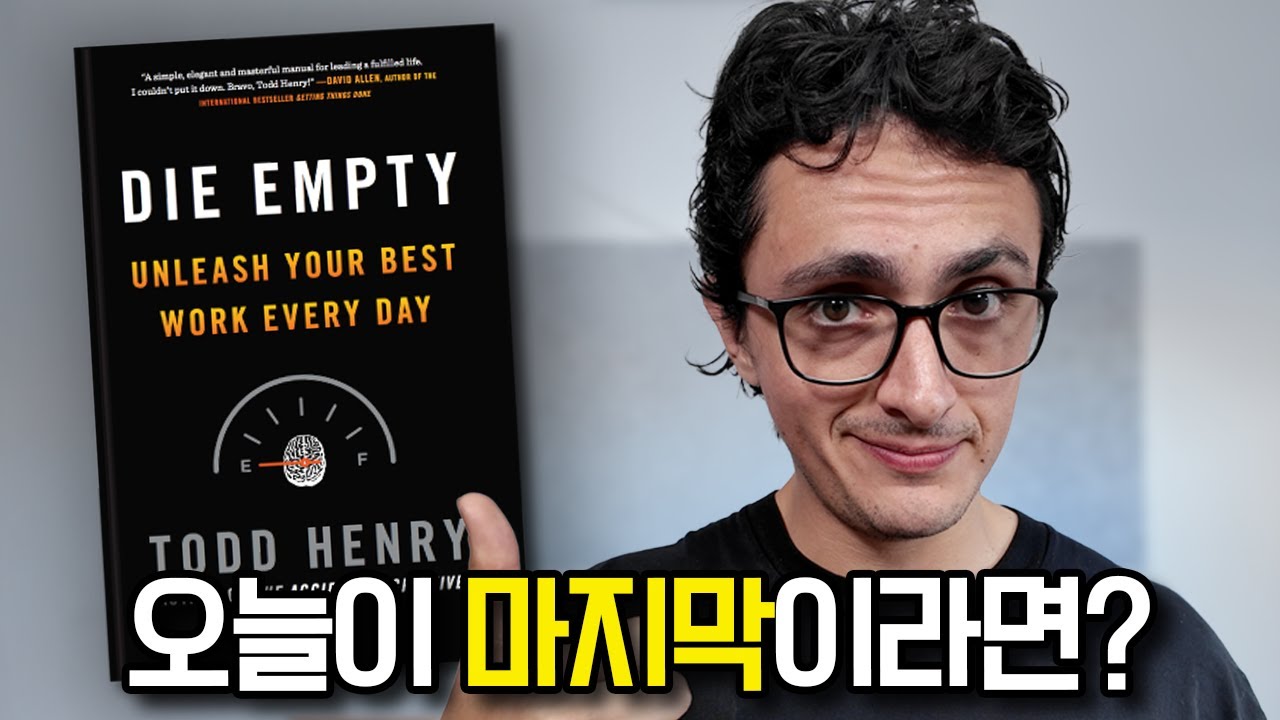
The most valuable land in the world is not in Manhattan, Hong Kong, Paris, or Seoul. The most valuable land in the world is the graveyard. Buried there are all the unwritten novels, never launched businesses, unreconciled relationships, and everything else people thought, I'll do that tomorrow, until one day, their tomorrows run out. That is one of the opening lines of the book, Thy Empty, by Todd Henry. A book I'm going to summarize today so that you can do your best work this year. The phrase die empty does not mean working yourself to death or neglecting every other area of your life to focus on work. It does not mean frantically checking off tasks or climbing the corporate ladder at any cost. Die empty means remembering that your days are finite and they are running out. Die empty means living with a sense of urgency, an urgency that comes from knowing that you are unique. You have a combination of skills, perspective, and experience that nobody else has to do work that only you can do. And if you don't do it, nobody will. But you waste time. You can't focus. Or you're too afraid to step out of your comfort zone. Die empty means understanding the importance of now. Structuring your life around daily progress. And refusing to let comfort, fear, or ego stop you from doing the work. Work in this context does not mean you're nine to five. Work is any value you create that requires your time, focus, or energy. Your career, parenting, relationships. If you are creating value where it previously didn't exist, that's work. Die empty is using your finite time, focus, and energy so that when you're gone, your work stands as evidence of who you were and what you believed in. On a daily level, die empty means going to sleep proud of the work you did. On a life level means taking nothing to the grave. To get there, we first need to understand the three types of work. Mapping is the work before work. the planning, the priorities, the reflection of why you do what you do. Making is doing the work, creating value, completing tasks, writing the code, sending the email, getting on the phone. But if you only focus on making and neglect the other two, you end up busy but not productive. You make progress that doesn't matter and you burn out. Mesh-ing is what most people skip because there is no immediate payoff. What is the most important? It's about growing, building new skills, staying curious, keeping up with your industry and those around it. Because it has no immediate payoff, most people focus on mapping and making, which is a mistake. You stop growing. You become efficient at things that no longer matter. Doing all three takes intention. By default, you will gravitate to one and neglect the others. Depending on which you neglect and which one you favor, you will fall into one of four buckets. Driver, drifter, dreamer, or developer. Drivers do mapping and making, but no meshing. They plan, execute, and get results, but only for today. Without meshing, they aren't growing. They aren't future-proving themselves. They burn out doing more of the same, without the skills to tackle new challenges. Drifters do making and meshing, but no mapping. They are curious, they learn, they execute, but without a plan, they bounce from project to project, never finishing anything. Dreamers do mapping and meshing, but no making. They plan, they learn, they prepare, but they never execute. They have big ideas and growing skills, but nothing to show for it. Always getting ready, never doing the work. The developer not the software kind this developer balances all three They plan they execute and they future themselves by constantly building the skills they will need next To die empty become the developer The problem is, most people never become the developer because seven things stand in their way. The seven deadly sins of mediocrity. No one plans to be mediocre. No one wakes up wanting to waste their potential. And yet, most people do. Not because they're lazy, but because mediocrity creeps in. One small compromise at a time, until years have passed and there's nothing to show for it. Scene one, aimlessness. Working without knowing what you're building. Mistaking movement for progress. Aimless people are busy. They check tasks off lists. They respond to emails and they show up. They might be doing good work, a lot of it, but none of it connects. No thread tying it together. At the end of the year, they can't point to anything that mattered. Scene two, boredom. Boredom itself isn't the problem. It's what you do with it. Boredom is a signal. It means you have outgrown what you're doing. Your mind is ready for something new. Most people ignore it or numb it instead of using boredom to their advantage. Scene three, comfort. Comfort kills greatness. When comfort becomes the goal, you trade future growth for temporary stability. You protect what you've built instead of building something new. This is how people plateau. They reach a certain level of success and stop growing and developing their skills. They stagnate and don't realize the world is moving without them. Comfort shrinks you. What feels safe today becomes the trap of tomorrow. Scene four, delusion. Believe in something about yourself that isn't true. If you don't know yourself honestly, you will build a life around a version of yourself that doesn't exist. And you will wonder why nothing ever feels right. Scene five, ego. You will fail. That's not the problem. The problem is when you can't admit it. Some people twist the facts, others pretend it never happened, anything to protect their image. Over time, they stop adapting, they stop learning. The ego won't let them. Scene six, fear. Fear of being wrong, fear of failure, fear of rejection. So you play it safe. You consume instead of create. You have no voice because you've never used it. Scene seven, guardedness. Great work doesn't happen in isolation. It happens in community. When life gets busy, relationships are the first thing to go. Isolation feels productive. It's not. You are cutting yourself off from people that help you grow. Seven sins, seven ways to live a mediocre life. Here's how to fight back. Seven practices, one for each sin. Practice one, define your battles. What's worth fighting for? Not tasks, battles. Find your North Star, the theme of your life and work. Some say find your passion, but we have misused that word. We use it for something we are remotely interested in, that not passion. The word passion comes from pati, the Latin root for to suffer. At the root of passion is suffering. To find your North Star, flip the question. Don't ask what brings enjoyment. Ask what you are willing to suffer for. Not all passions are equal. You want a productive passion. One that's others-focused, not self-focused. To find your productive passion, pay attention to three things. Compassionate anger, obsession, and hope. Compassionate anger. What gets your blood boiling? What creates urgency to act? This doesn't mean working for a social cause. It could be anger on behalf of an underserved market, a group of people that need something and can't get it. Obsession. What problems do you keep coming back to? What do people ask you for help with? Look for this overlap the problem you can stop thinking about One you are uniquely qualified to solve Obsession followed by action becomes passion Hope Where are you helplessly optimistic What will you keep working on when others quit? Pay attention to where you have more hope than everyone else. There's something there. To avoid aimlessness, stand for something. Find the battles only you can fight. Pour your time, focus, and energy into them. Practice two, be fiercely curious. Intentional curiosity kills boredom. Switch from entertainment to engagement. Stop filling empty moments with garbage. Start asking questions. Curiosity is a muscle. Here's how you train it. Keep a list of questions. Pay attention to the things you don't understand but scroll past anyways. Don't ignore them. Write them down. When you're bored, don't reach for entertainment. Reach for your list. Pick a question and chase the answer. Do it with AI. It couldn't be easier. Chasing answers takes you to unexpected places, different industries, different topics. That's where your next great idea lives. Another way to train curiosity, prototype relentlessly. Prototyping takes the pressure off. You are in building a final product, writing a full book or launching a new company. You're just testing an idea. Start prototyping and two things happen. You make progress without realizing it and you open the door to ideas worth taking seriously. Prototype with AI. Do it often. Magic will follow. It is hard to prioritize curiosity when your to-do list is screaming. Do it anyways. Curiosity makes you better at what you do now and prepares you for what's next. Practice three, step out of your comfort zone. Everything you ever wanted is waiting for you on the other side of discomfort. But we don't get uncomfortable often enough. We are wired for comfort. Two strategies to make discomfort a habit, not a rare event. First strategy, the permanent record. Imagine someone is following you, taking notes on how you spend your day, how you approach your work, how you treat people. At the end of the day, they will write a book about your life based on what they saw that day. Imagine tomorrow is on your permanent record, the only evidence of who you are. Would you act differently? How you spend one day is how you spend every day. Second strategy, step, sprint, and stretch. A step goal is small and daily, forward progress, even if tiny. A sprint goal groups step goals together, something you can finish in two weeks or less. A stretch goal is the big one, a clear, measurable outcome. Start with the stretch. Break it into sprints. Break those into steps. Focus only on today's step. The rest takes care of itself. Have goals in different areas. Work, health, intellectual growth, all of it. Hard to get bored when you're growing in multiple directions. Practice four. Know yourself. Delusion dies when you get honest about who you really are. First, kill memetic desire. Wanting something because other people want it. Travel somewhere far. Stay long enough to forget who you're supposed to be. Let the real you surface. Then listen, pay attention to what resonates. Notice what you gravitate towards when there is no audience, no likes, no approval. Just you. Make a list of people you admire and read their biographies. Study how they lived and the decisions they made. You will find things you want to emulate, values that feel right without explanation. Then, via negativa, the art of subtraction. Know yourself by what you remove, not what you add. Question your assumptions about yourself, about the work, about the world. Start with the basics. things people would laugh at you for questioning. Some of the most accepted truths aren't true. They are just old, just assumed, just repeated. Question everything, even the obvious, especially the obvious Only by knowing yourself you can make a unique contribution to the work If you let memetic desire others expectations and false assumptions shape your work it won be yours and it won be great Practice five, be confidently adaptable. Adaptability kills ego. Be aggressive about your work. Fight for your ideas. Speak your mind. But know the difference between confidence and ego. Sometimes the work isn't good enough. Sometimes the idea was wrong. Sometimes you need to scrap it and start over. That's not failure, that's growth. The confident person admits what is not working and adjusts. The ego-driven person doubles down and sinks with the ship. When recognition becomes the goal, the work suffers. You start protecting your position instead of doing what's right. Ask, what can I offer? Not, what can I get? The easiest way to kill ego is make the work about others, not yourself. Practice six, find your voice. The work only you can do. The work that actually adds value. That's your voice. Your voice comes from synthesis. Taking what you have learned, filtering it through your experience, and creating something new. It comes from contribution, not consumption. You can't find your voice by watching, only by doing. Take small risks every day. Write before you're ready. Create before you're confident. Launch before you're finished. Face rejection. Success isn't guaranteed. If you don't risk failure, you guarantee you'll never win. We are entitled to the work, but not the results. Practice seven. Stay connected. The lone genius locked in their studio. Building a masterpiece alone, that's not the goal, it's the trap. Great work requires others. Leonardo da Vinci had mentors, collaborators, and rivals who pushed him. Every genius did. You need three types of people. Mentors. People ahead of you who have done what you are trying to do. One conversation with them saves you a year of mistakes. Peers. People beside you who challenge your thinking. Not cheerleaders. Sparring partners. Apprentices. People behind you that force you to articulate what you know. Teaching sharpens your own understanding. Accountability prevents drift. Community keeps you sharp. You can't do your best work alone. That's it. Seven scenes, seven practices. The question, how do you make this stick? Knowledge isn't the problem. You know what to do. Action is the problem. The solution, a daily checkpoint. 50 minutes every morning. Five questions. One, how will I show up today? Not what will I do. How will I be? What version of myself am I bringing to this day? Two, what battle am I fighting today? Not your to-do list, your real work. the one thing that moves the needle. Everything else is noise. Three, who will I engage with today? Think about the people in your life. How can you serve them? Four, what needs to go? You can't do everything. What are you holding on to that's stealing time from what matters? And five, what will I do for myself today? Not your job, you. What skill are you building? What curiosity are you chasing? What have you been meaning to start? Before you finish, two more things. Be grateful. Meditate on what you have and not on what you lack. Gratitude changes how you show up. Fall in love with the process and not the outcome. The process. The outcome is out of your hands. The process is the only thing you control. 15 minutes, five questions every day. This is how you empty yourself. Not once a year, not when you feel inspired daily. Your job is a noun. Your work is a verb. The cemetery is full of people who had jobs. Don't confuse the two. The question isn't whether you have great work to do. You do. The question is whether you will do it. Die empty.